Can You Use Glass Cleaner on Mirrors?
When you’re tackling your weekly house cleaning, it’s tempting to reach for a single blue bottle of glass cleaner for every shiny surface in the room. However, while mirrors look like glass, they are actually complex layered objects. Understanding the chemistry behind your cleaning products can save you from permanently damaging your household’s most reflective surfaces.
Quick Answer: Yes, But It Depends
The short answer is yes, you can generally use most commercial glass cleaners on modern mirrors. However, the caveat lies in the application method and the age of the mirror. Using the wrong technique can lead to “black edge”—a permanent deterioration of the mirror’s silver backing—even if the cleaner itself is technically “safe” for glass.
When Glass Cleaner Is Safe for Mirrors
For the majority of modern mirrors produced in the last few decades, standard glass cleaners are perfectly effective at removing fingerprints, toothpaste splatters, and dust.
Standard Bathroom Mirrors
Most modern bathroom mirrors are designed with a protective coating on the back. For these everyday surfaces, a high-quality glass cleaner is safe for removing the heavy steam residue and oils that accumulate in high-moisture environments. The key is ensuring the cleaner does not pool at the bottom or seep behind the glass.
Framed Mirrors
Glass cleaner is safe for the reflective surface of framed mirrors, provided you are careful about the frame material. If the mirror is housed in wood, leather, or certain treated metals, the chemicals in the glass cleaner (like ammonia) can strip the finish off the frame. Always apply the cleaner to your cloth first to avoid overspray hitting the frame.
When Glass Cleaner Can Damage Mirrors
Mirrors are created by applying a reflective silvering or aluminum coating to the back of a pane of glass. This coating is highly sensitive to chemicals.
Antique Mirrors
If you have an heirloom or an antique mirror, avoid commercial glass cleaners entirely. Older mirrors often have thinner protective backings or no backing at all. Chemicals like ammonia can eat through the delicate silvering process used in the early 20th century, causing unsightly dark spots or a “cloudy” appearance that cannot be repaired without professional resilvering.
Mirror Edges and Backing Damage
The most vulnerable part of any mirror is the edge. If you spray glass cleaner directly onto the mirror, the liquid runs down and “puddles” in the bottom edge or frame. Through capillary action, the cleaner is sucked behind the glass. This chemical exposure causes desilvering, where the reflective coating oxidizes and turns black. Once this “black edge” appears, the mirror is permanently damaged.
How to Clean Mirrors Without Streaks
Achieving a crystal-clear, streak-free finish is a point of pride for any homeowner. Follow these professional steps to get that “invisible” look.
Spray Cloth, Not Mirror
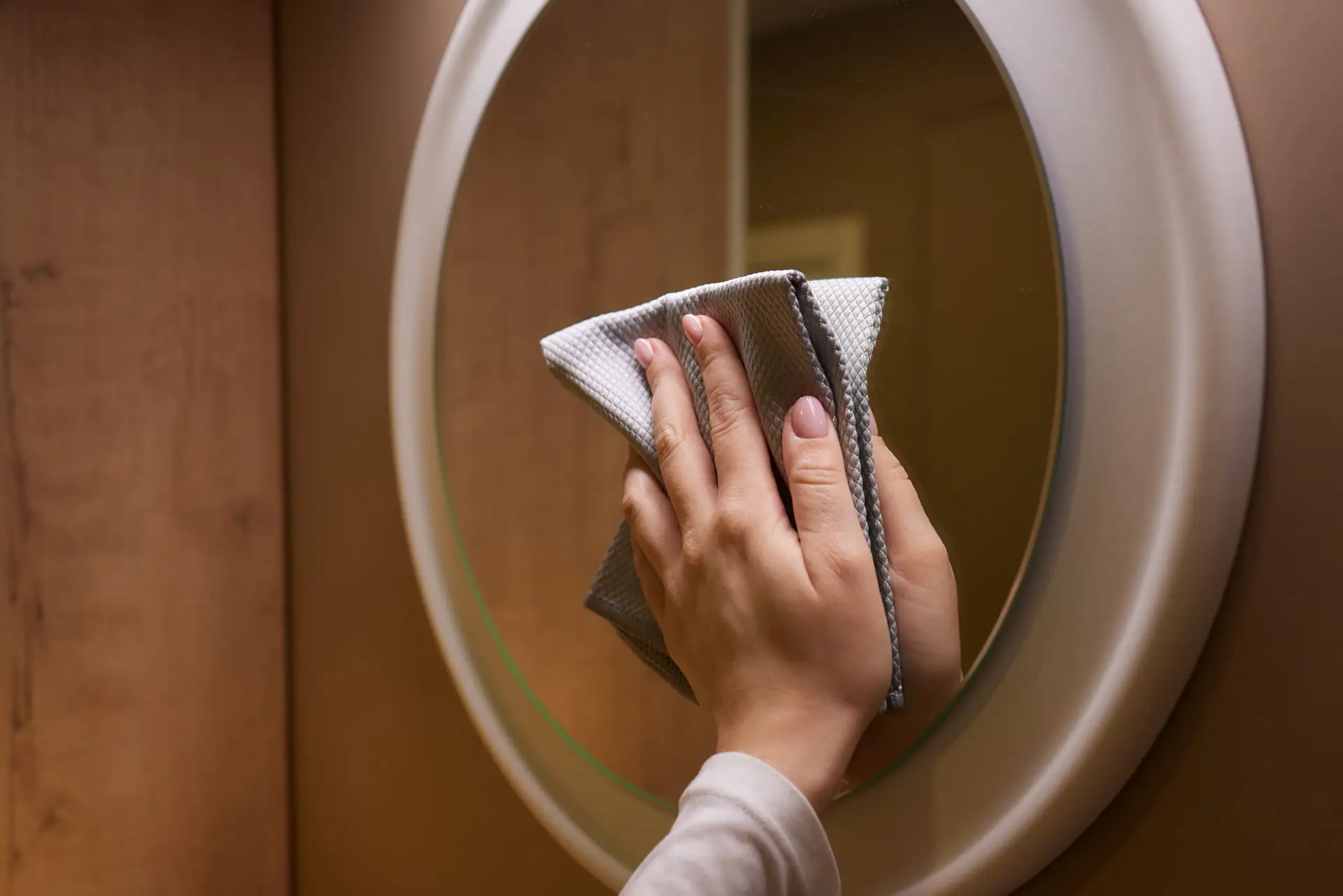
This is the golden rule of professional cleaners. Never spray the mirror directly. Instead, mist your cleaning solution onto your cloth. This prevents the liquid from running into the edges and protects the silvering from chemical rot.
Use Microfiber
Forget paper towels or old newspapers. Paper towels leave behind lint and “dust” streaks, while modern newspaper ink can actually smudge some glass surfaces. Use a clean, tight-weave microfiber cloth. It is designed to grab oils and lift them away from the surface rather than just moving them around.
Buff Dry
After wiping the mirror with your dampened cloth, immediately follow up with a second, completely dry microfiber cloth. Use circular motions to “buff” the surface. This removes any remaining moisture before it has a chance to evaporate and leave behind mineral streaks.
FAQs
Why do mirrors get streaky?
Streaks are usually caused by three things: using too much cleaning product, using a dirty cloth that is simply redepositing oils, or mineral deposits in your water. If you see a “milky” film after cleaning, you are likely using a cleaner with too many detergents or surfactants.
Is vinegar better?
Many professionals prefer a 50/50 mix of white distilled vinegar and water. It is highly effective at cutting through “soap scum” in bathrooms and is generally safer for the environment. However, vinegar is acidic; the same rule applies—never let it sit on the edges of the mirror where it can touch the silvering.
Can ammonia damage mirrors?
Yes. Ammonia is a powerful solvent found in many “blue” glass cleaners. While it is great for cutting through heavy grease on window glass, it is the primary culprit in mirror desilvering. If you are cleaning a high-value or sentimental mirror, always look for an ammonia-free glass cleaner.
Professional Cleaning Services in MA
Maintaining the clarity of large mirrors, glass partitions, and decorative glass features can be a daunting task, especially in large Massachusetts homes or commercial spaces. At Jama Cleaning, we specialize in high-end residential and commercial cleaning throughout the state.
Our team uses professional-grade, pH-balanced solutions and lint-free buffing techniques to ensure your mirrors remain flawless and free from edge-rot. Whether you need a one-time deep clean for a move-in or recurring maintenance for your office or home, we provide the expert touch your surfaces deserve.
Ready for a spotless home? Contact Jama Cleaning today for a professional cleaning estimate and let us make your mirrors shine like new!